
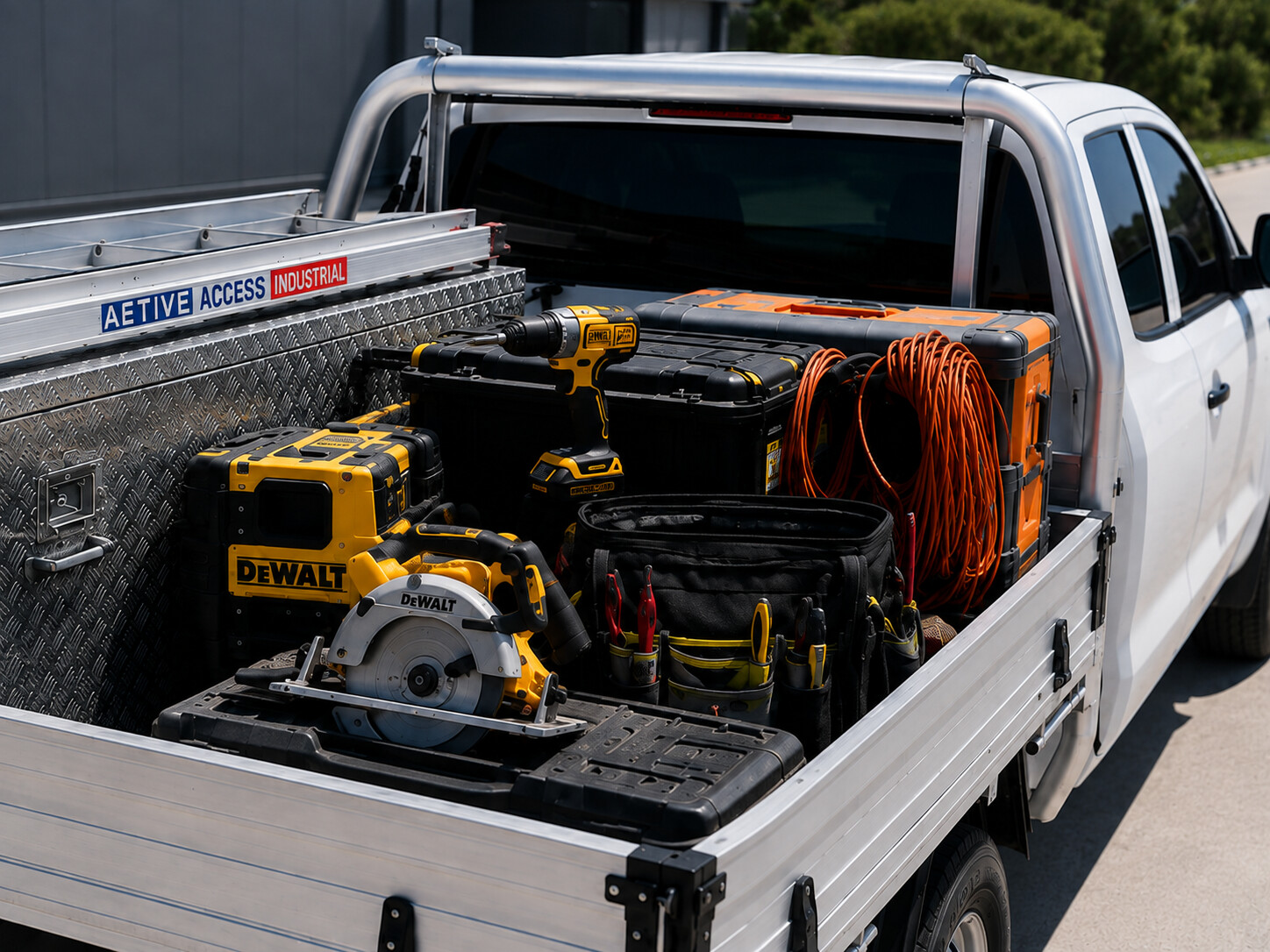
Every tradie knows the feeling. You get home, you look at the ute sitting in the driveway loaded with about fifteen grand worth of gear, and you think, she’ll be right.
Usually she is. Until she isn’t.
Queensland Police reported more than 25,000 tools stolen across the state in the 2024-25 financial year, and utes parked overnight are one of the most common targets. Police have specifically warned Brisbane and surrounding tradies about offenders working driveways and worksites looking for exactly that.
The problem isn’t just the replacement cost. It’s the Monday morning you can’t work.
Why the home garage stops working
Most tradies start out storing gear at home. It’s free, it’s close, and for a while it’s fine.
Then the business grows. You pick up a second trailer. You start buying materials in bulk because the pricing is better. The garage fills, then the side of the house, then the ute never gets unloaded because there’s nowhere to put anything.
If you’re in one of the newer Logan estates, the problem hits faster. Blocks are tighter, garages are smaller, and covenants often restrict what you can park on the driveway or store in view of the street. A double garage with a car in it doesn’t leave much room for a trade business.
What a storage unit actually solves for a trade business
Tools stay locked up overnight. Unloading the ute is a hassle. Doing it at a secured facility with CCTV and your own personal lock is a lot less of a hassle than replacing a full kit and arguing with an insurer.
Bulk buying becomes worthwhile. If you’ve got somewhere to put it, you can order materials at volume pricing instead of paying retail for what you need this week.
Your house stops being a warehouse. Ask anyone who has run a trade business out of a family home. Getting stock, offcuts and equipment out of the garage tends to improve things at home considerably.
Vehicles and trailers get a proper home. Work trailers, tippers, excavators and site gear don’t need to be squeezed into a residential driveway. Hardstand space handles the oversized stuff.
What size do most tradies need?
It depends on whether you’re storing tools or stock.
Tools and equipment only. A sole trader storing a kit, a compressor, ladders and a few tubs usually doesn’t need much. Our smallest units start at 9m², which is roughly a single garage bay.
Tools plus materials. Once you’re holding stock, pipe, timber, fittings or consumables, you want room to shelve it and walk between it. Somewhere in the 18m² range tends to be the sweet spot.
Full operation. Larger crews, multiple kits, bulk materials and a work vehicle inside. Our units run up to 50m².
Trailers, machinery and oversized gear. Outdoor hardstand is cheaper per square metre and far easier to reverse into than an enclosed unit.
The honest answer is that most people guess too small the first time, then realise they can’t get to anything without unloading half the unit. If you need to access gear regularly, leave yourself an aisle.
Outdoor storage: where the big gear goes
Not everything belongs behind a roller door. A lot of what a trade business owns is on wheels, and trying to squeeze it into an enclosed unit is expensive and awkward.
That’s what hardstand is for. It’s open, sealed outdoor space inside the facility, and it’s the sensible option for anything you’d otherwise be parking on the street or wedging down the side of the house.
What tends to live outside:
- Work trailers, box trailers and plant trailers
- Tippers, tandems and second work vehicles
- Bobcats, mini excavators and other small plant
- Scaffolding, formwork, site fencing and props
- Long materials like pipe, timber and steel that won’t fit in a unit anyway
- The caravan or boat that’s been taking up the driveway since you bought the trailer
Why tradies use it:
It’s cheaper per square metre than an enclosed unit. If the item can handle weather, you’re paying for space rather than walls and a door you don’t need.
Driveways and covenants stop being a problem. Most of the newer Logan Village, Yarrabilba and Jimboomba estates have restrictions on what can sit on a driveway or in view of the street, and plenty of tradies have had the letter from the body corporate to prove it. Moving the trailer offsite solves it permanently.
You can hook up and go. Reversing a trailer out of a residential driveway at 5am is a different experience to driving into an open yard, hitching, and leaving.
It gets the vehicle out of the fleet’s way. If you’ve got a second ute or a machine that only comes out for certain jobs, it doesn’t need to be at home taking up a bay year round.
A few things worth doing if you’re storing outdoors:
- Fit a decent coupling lock and wheel clamp on trailers. An unsecured trailer is the easiest thing on a yard to move.
- Cover or tarp anything with fabric, vinyl or exposed upholstery. Queensland sun does more damage than people expect.
- Don’t leave tools or valuables inside a trailer or vehicle stored outdoors. Put those in a unit.
- Disconnect the battery or fit a trickle charger if the vehicle is sitting for months.
- Check the tyres before you tow. Anything parked long term will need pressures done.
If you’re not sure whether your gear should go in a unit or on hardstand, the rough test is simple: if it’s weatherproof and on wheels, store it outside. If it’s tools, stock or anything that hates humidity, put it in a unit.
A few practical things worth doing
Record your serial numbers. Police consistently point out that unmarked tools are near impossible to trace and easy for thieves to move on. Photograph everything and keep a list. It also makes any insurance claim far smoother.
Check what your insurance actually covers. Plenty of portable equipment policies treat tools differently depending on where they’re stored, whether it’s after hours, and whether specific security measures were in place. Worth reading before you need it, not after.
Shelve it properly. Cheap racking turns a unit from a pile into a working store. You’ll get more into the same space and spend less time hunting.
Set the unit up around your week. Put the stuff you touch daily near the roller door and the seasonal or backup gear at the back.
Storage that suits how tradies actually work
Self Storage Logan is a brand new, family owned facility in Logan Village, with two gate entry points on Industrial Ave and Quinzeh Creek Road so you’re not doing a three point turn with a trailer on. There’s CCTV monitoring throughout, and each unit is secured with your own personal lock, so nobody else has a key.
Alongside the units, we’ve got outdoor hardstand for trailers, work vehicles, plant and oversized gear, so you can keep the tools in a unit and the towables outside without running two arrangements at two different places.
We’re not a big corporation with a call centre and an annual rate rise. We’re locals, and a fair chunk of our customers are Logan Village, Yarrabilba and Jimboomba tradies who just needed somewhere sensible to put their gear.
Tell us what you’re storing and we’ll tell you what you need, unit, hardstand, or both. Book online in minutes, or give us a call.