
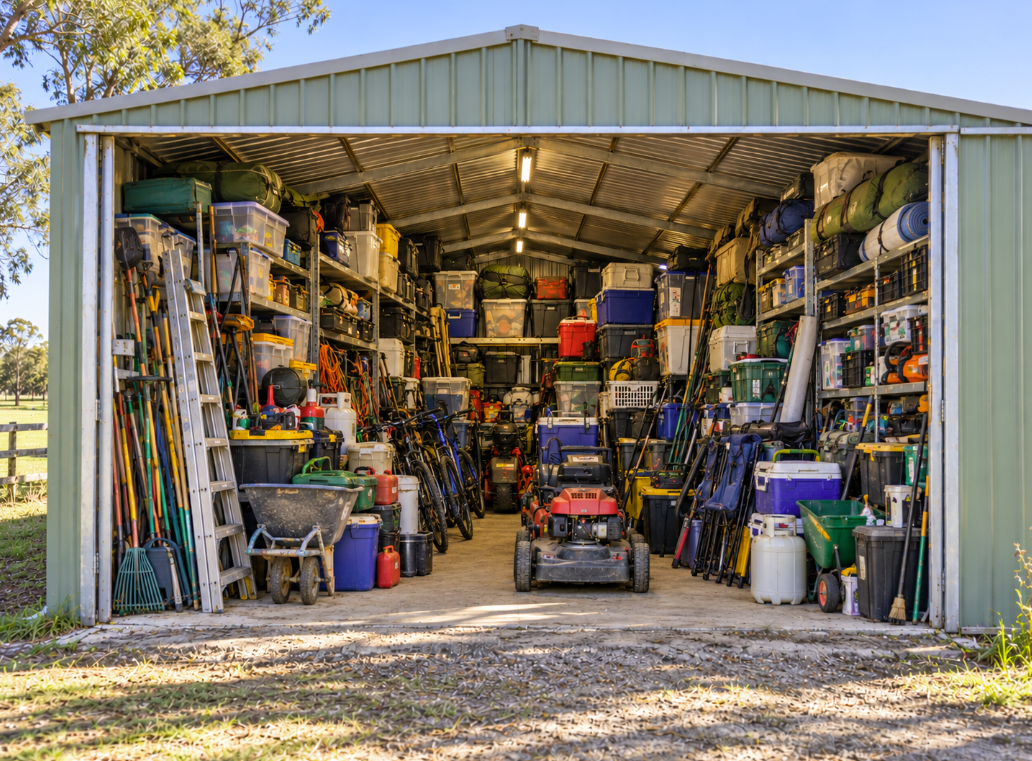
The shed was meant for the ride-on. That was the whole idea when you bought the block.
Now it holds the camping gear, two saddles, the leftover decking boards, a box trailer you use twice a year and the kids’ old bikes nobody will part with. The ride-on lives under a tarp beside the water tank.
If that sounds familiar, you’re not alone. Plenty of acreage owners around Logan Village, Cedar Grove and Woodhill run into the same problem, usually sooner than they expected.
Why more land doesn’t mean more room
Acreage gives you space to own more things. It doesn’t give you more places to keep them out of the weather.
A suburban garage fills with boxes. A rural shed fills with things on wheels: floats, trailers, mowers, quad bikes, the tinnie. Each one takes a full bay, and none of them stack.
The usual answer is another shed. That’s a fine answer if you have the budget and the patience, but it’s rarely quick. There’s the slab, the build itself and often a council approval before any of it starts. Requirements vary by property, so check with Logan City Council before you plan around one.
A lot of people just want the gear dry and the shed back while they work out the long-term fix. Sometimes the long-term fix turns out to be not building at all.
What belongs on hardstand
Hardstand is open, sealed outdoor space inside the facility. No walls, no roller door, just a level surface behind a locked gate. Because you’re not paying for a building around it, it costs less per square metre than an enclosed unit.
It suits anything built to live outside anyway:
- Horse floats and stock trailers
- Box trailers, camper trailers and tandem setups
- Caravans and motorhomes
- Boats on trailers
- Tippers and second work vehicles
- Long materials like pipe, steel and treated timber
If it already spends its life parked in the paddock, hardstand is the same idea with a gate, CCTV and nobody’s cattle leaning on it.
What belongs in a unit
An enclosed unit is a lockable space with a roller door and drive-up access, so you can back the ute or trailer straight to it and unload.
Gear that hates rain and dust. Tents, swags, camp kitchens and fridges last a lot longer out of a shed that leaks every summer storm.
Saddlery and tack. Leather doesn’t love humidity anywhere in Queensland. A clean, dry unit is better than a damp corner of the feed room, but give it airflow and check on it through the wet season.
Tools and building materials. Anything that rusts, swells or goes missing from an open shed. Bagged products, fittings, power tools and the good ladder.
The ride-on and the quad. Small machines with engines fit well in an enclosed unit. Anything the size of a caravan or a full-size boat goes on hardstand instead.
A rough test for sorting it
If it’s weatherproof and on wheels, store it outside. If it’s leather, canvas, tools or anything that hates humidity, put it in a unit.
Most acreage owners end up with a bit of both. The float goes on hardstand, the tack and camping gear go in a small unit, and the shed finally takes the ride-on again.
If you get it wrong, it’s not a big deal. You can move between an enclosed unit and hardstand without penalty, so you’re not locked into your first guess.
Before you drop off a float or trailer
Ten minutes at home saves a headache later.
- Clear out the feed and hay. Anything edible left in a float is an invitation to rodents.
- Check the tyres. Pump them up before it’s parked for months, and look again when you visit.
- Fit a coupling lock. A wheel clamp is worth adding if the float or trailer is valuable.
- Photograph the serial numbers and VIN. Keep them on your phone, not in a folder in the shed.
- Disconnect the battery on anything with one, including the ride-on.
- Check your insurance. Ask your provider whether the float, trailer or contents are covered while stored offsite. Policies differ, so it’s worth confirming.
Getting in with a long load
Self Storage Logan is in Logan Village, with two gate entrances to the one facility. Gate 1 is at the end of Industrial Ave and Gate 2 is at 49–55 Quinzeh Creek Road.
Two gates means room to bring a float or a tandem through without a tight three point turn. Every unit has drive-up access, so you’re unloading at the door, not carrying gear across a car park.
The gates are open 24/7, every day of the year. That suits an early start for a show or a late return from the coast. The office runs Monday to Saturday, 8am to 6pm, so call ahead on 0472 670 853 if you’d like a hand working out what you need.
Get the shed back
We’re a family-owned facility, built from the ground up by people who live around here. Terms are month to month with no minimum stay, so you can store the float for the off-season and stop when you need to. It’s your lock, your key, and nobody else has access.
Tell us what’s crowding the shed and we’ll tell you whether it needs a unit, hardstand or both. Book online, or come and see what we’ve built.